
BENJAMIN APPEL’S FORTRESS IN THE RICE: FORGING THE REVOLUTIONARY CONSCIENCE OF THE EMPIRE
by E. SAN JUAN, Jr.
Benjamin Appel (1907-1977) may be the most neglected or forgotten radical-democratic novelist of mid-century United States. While his first Depression-era novel, Brain Guy (1934) was re-published in 2005 together with Plunder (1952), a racially scored expose of underworld racketeering in war-torn Philippines, Appel still remains unknown to critics and cultural historians. The last significant, incisive commentary on Appel appeared in Alan Wald's Trinity of Passion: The Literary Left and the Anti-Fascist Crusade (2007) which focused on The Dark Stain (1943), the last of the trilogy beginning with Brain Guy and The Power House (1939). The trilogy became the basis for Appel's reputation as a novelist specializing in detective and crime fiction in a milieu of poverty, prostitution, corruption, where "the morass of racial prejudice devours even those of good intentions" (Social Archive 1977).
The New York Times and The New Yorker praised Appel as the authentic voice of the streets of urban America. Apropos of The Dark Stain, Wald emphasized Appel's unqualified support for President Roosevelt's anti-fascist crusade as part of Popular Front politics. Its message was conveyed through the trappings of a hardboiled detective novel appropriate for the conspiratorial atmosphere of a protofascist environment, Wald adds, with Dickens and Tolstoy's psychodrama coalescing with Upton Sinclair and Theodore Dreiser's realism (2007, 143). Five years after this chronicle of race war in the "internal colony," Appel was addressing "the misery and despair of Asia--a misery and despair shared by nearly all the nonwhite people of the world" (1951, 424)--symbolized by the struggle for the "bowl of rice." that is, the common humanity founded on material existence. From 1945 to 1948 when the Cold War flared up, Appel's sympathy for the underdog widened and deepened to embrace the brutalized peasants of colonial Philippines in his account of their struggle against Japanese colonialism and American racism/chauvinism in Fortress in the Rice (1951). How did this happen?
From 1935 to 1941, Appel was an active member of the left-wing League of American Writers whose black members included Richard Wright, Langston Hughes, Ralph Ellison, and many others. Apart from multiethnic constituencies, the League provided opportunities for delegates from other countries to participate in its meetings. Appel might have encountered the left-wing Filipino delegates to the Third Congress in June 1939 where anti-imperialist speeches were made. Franklin Folsom describes Appel's stance as "independent, creative, and humorous" (1994, 254). Appel signed the League's "Call to the Writers Win-the-War Congress" in November 3, 1942 to "articulate the will and desires of the people," to remember and avenge the victims of Pearl Harbor, Lidice and Stalngrad. The writers would urge the opening of a second front in Europe to defeat "the fascist enslavers and murderers of mankind." One of the aims of using "words as weapons" was for "the democratic integration in this people's war of the total energies of the Negro people, by fighting with them against discrimination in any form whether in civil life or in the armed forces" (Folsom 1994, 348).
Birth of the Partisan Observer
Given his humanist-populist sympathies, Appel eagerly joined this mobilization of writers for victory against global fascism and militarism. But what brought him to the only U.S. colony in Asia occurred after his 7-months stint in 1945 at the Office of War Mobilization and Conversion in Washington, DC. Appointed a special assistant to the U.S. High Commissioner to the Philippines, Paul McNutt from November 1945 to March 946, Appel was in the Philippines engaged in field investigations of the social, political and cultural conditions of the islands, including personalities and specific incidents, prior to the grant of formal independence. The result was the rich, hitherto unpublished compendium of letters to his family entitled "Manila Diary," the raw material of his two novels, Fortress and Plunder. I believe this 200-pages manuscript is one of the most valuable personal testimonies by an American "insider" concerning that momentous transitional stage in which the issues of collaboration, agrarian conflict, military insubordination, general lawlessness, and political confusion dominated the news. It was the interregnum that would decide future United States' policies toward the country after the grant of formal independence in July 1946, a fateful event coinciding with the beginning of the Cold War.
In several letters to prospective publishers, Appel provided the background to the genesis of Fortress. He calls attention repeatedly to the “theme of the Assiatic peasant’s struggle for rice and land and has said, ‘my hero in this novel are the billion Asiatics, the common man across the Pacific who for lal his differencces is not too dissimilar from the cfommon man of the big American cities” (Appel xxx). Appel considered the vexed American-Philippines entanglement as a microcosm of all Asia. The time he spent in the Philippines “was a turning point in American policy in the Orient:
After meeting Sergio Osmena [then president of the Philippine Commonwealth] and Manuel Roxas [elected first president of the Philippine Republic; exonerated by Gen, MacArthur for his collaboration with the Japanese govt.] etc., I became interested in the history of the dominant Nacionalista Party over half a century. After attending the trials of General Yamashita, I became interested in the Japanese policy during the occupation, particularly in its propaganda against the West. After meeting the guerilla leaders, both American and Filipino, I became interested in unraveling the feud between the Hukbalahaps [the Communist-led guerilla army against the Japanese forces] and the American-led guerillas. I discovered that there was one common cord binding together such historical phenomena as the Nacionalista Party with its drive for independence from the United States, the Japanese occupation, the bitter feud between the guerillla groups: who should own the land. Landlord or peasant? Today, the land-rice revolt is continuing not only in the Philippines but throughout all Asia. In my opinion, it is the greatest historical fact of our times, involving the fate of half the world’s population (Appel xxxx).
At a crucial juncture in the relations between the United States and its only colony in Asia, the Philippines, Appel happened to be a living participant and witness in the momentous transition of the Philippines from colonial "Commonwealth" status to an independent republic. As already mentioned, Appel was appointed an official historian of the McNutt Commission in 1945-46. This unusual vantage point enabled Appel to observe firsthand those crucial months immediately after the liberation of the country from Japanese occupation, painful weeks and months of restoring normalcy to a society wracked with centuries of peonage, feudal-based pauperization, rampant injustice, and sharp class divisions. Those social ills are a legacy of 300 years of Spanish domination. four years of savage Japanese occupation, and forty years of U.S. colonial rule.
Based on his intense social investigation and wide study of the historical archives, Appel produced two novels about Philippine society and the role of American soldiers, politicians, adventurers: Plunder is an interethnic drama dealing with American soldiers engaged in corrupt collusion with Filipinos. Chinese and other groups immediately after World War II, while Fortress in the Rice (1956) narrates the vicissitudes of the Huk peasant rebellion in the fifties. Although the second novel has been reviewed widely, it has not been given the serious reading and appraisal that it deserves as one of the most perspicuous critique of racialized colonial ideology operating in the psyches of both masters and subalterns, with subtle discrimination of its effects in a wide variety of characters representing different cultural traditions and social histories.
Between Two Worlds
The difficulty of a just estimate of Appel's achievement is surely the ignorance of, or indifference to, the half-a-century of U.S. colonial rule in the Philippines. One example is Robert Lowry who claims to appreciate through the flat journalistic prose, cliches and overwiting the novelist’s “interested eye roving over the whole social scene of occupied Manila and the guerilla country beyond” which comprise “a good documentary” about the “plight of the Philippine masses and the reason for their revolutionary ferment” (1951, 16, 36). Counterpointing this is Harrly Slowocher’s estimate that Appel’s achievement belongs to “world literature” in the same class as Hemingway’s For Whom the Bell Tolls and Malraux’s Man’s Fate. Slowocher argues that Appel shows “greater sensitivity to the complexities of human emotions under the terrible stressess of war, loneliness and hunger” (xxx, 70). What endows the novel with permanent stature iss “the story of particular human destinies,” one which “encompasses the making or unmaking of the world-wide fraternity and freedom. It shows that behind the revolution for a bowl of rice, there is the craving for dignity and love” (xxx, 70). The indifference of one and the enthusiasm of the other may be read as symptomatic of the confused American understanding of the situation of the Philippines and its people ever since the US annexed the territory in 1898.
Knowledge of the Philippines as the only direct Southeast Asian colony of the United States has been obtuse and sparse. The entry in The Reader’s Companion to American History, for example, cites the problem of violent annexation in conjunction with the defeat of Spain in the Spanish-American War of 1898-99: “Anti-imperialists opposed to taking over a foreign people without their consent and holding them in a colonial condition objected bitterly” after which the US poured aid. In 1946, the US “granted the Philippines their independence, though still maintaining bases and political influence there” (1991, 836). Conversion of the colony into a neocolony was mainly effected by the Bell Trade Act and the Military Bases Agreement of 1947, economic, political and mlitary conditions that perpetuated dependency and preserved the feudal landlord system on which oligarchic power has rested for over three hundred years of Spanish, Japanese and American colonial domination.
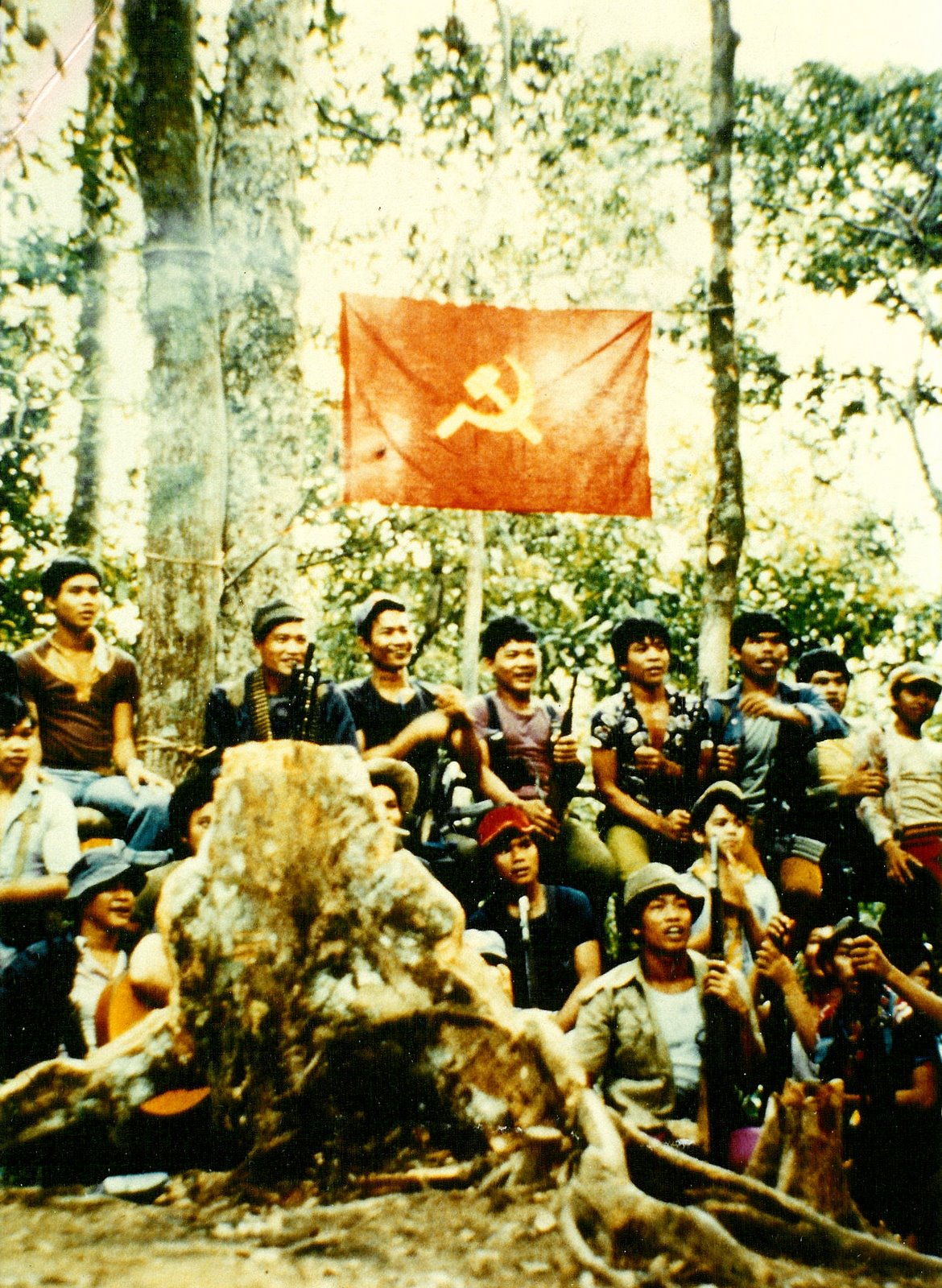
Clearly, World War II caused a rupture in the system of unequal relations between colonized subalterns and imperial masters. It released popular energies catalyzed by the resistance to Japanese brutality. While Filipino resistance to US colonialism never stopped despite 1.4 million casualties during the Filipino-American War of 1898-1913, concessions were granted by the US to win over middle-strata and intelligentsia. However, the majority of citizens, over 80% of the toiling masses, with peasants chained to peonag in the fields, mines, and workers subjected to dehumanized conditions. They continued the revolutionary traditiion begun in the 1896 insurrection against Spain up to the twenties and thirties, finally organizing and mobilizing themselves against the Japanese occupation. The group that led this fight was the Hukbalahap composed of,, socialists, communists, and other nationalist forces whose Popular Front policies supported US anti-Japanese guerillas called USAFFE (United States Armed Forces in the Far East). They were not only fighting the japanese but also their Filipino collaborators—the puppet government and its constabulary police and soldiers—defending landlord property and oligarchic entitlements, in short, the status quo before the war. It was ultimately what Appel calls “a battle for the land,” for the radical transformation of the economic and political structures that entrenched a privileged minority backed by the US government that has been oppressing Filipinos.
` Half a century of US tutelage had resulted in pauperization of the peasantry and immiseration of the working class and indigenous or ethnic communities due chiefly to the polarization of land ownership. Historian Jonathan Fast found that “in 1903 an estimated 81 per cent of all land holdings were worked on directly by their owners; by 1938 this figure had fallen to 49 per cent and in the post-war decade the rate of polarization increased further. By the 1950s an estimated two thirds of all the rural population were landless and of these the great majority were sharecroppers working the fields for a small percentage of the crop” (1973, 76). On the eve of the Pacific War, with the deteriorating socioeconomic conditions, the increasing rate of land tenancy, heavy rural indebtedness and pauperization, militant peasant unions demanded reforms for land redistribution and the end of landlord control over the courts and the bureaucratic apparatus. This is essentially what Appel, in the Author’s Note at the end of the book, referred to as the “tidal wave” whose heart is
“the bowl of rice.”
Private landlord armies and vigilante groups controlled by the elite suppressed any agitation, however peaceful and legal. The war changed the situation: the elite mestizo Narciso Ferrer (in Appel’s novel) abandons his hacienda for refuge in Manila and urged the Japanese-backed Philippine Constabulary (under General Mabanta) to protect his rice-fields, to no avail. Ater establishing local governments, the armed peasantry organized by the Huks implemented land redistribution, punishment of collaborators, and the denial of rice harvests to the Japanese occupiers, the famous “rice struggles.” When the US returned in 1944, the Huks welcomed the Americans as fellow comrades in the anti-fascist struggle and carried out an initial voluntary demobilization in their regional and local guerilla infrastructures. Instead of being reward, the Huks were disarmed, arrested, and their leaders killed. In effect, American liberation of the islands spelled the return of the old order of mestizo elite exploitation of the majority of peasants and workers, for Appel a tragic mistake of moral blindness to the past and a sabotage of the US commitment to democratic ideals.
Fortuitous intervention
In that fateful assignment to the Philippine theater of class and racial antagonisms, Appel felt he was “living at the center of a typhoon,…a year of momentous decisions when all Asia heldits breath, waiting for the United States, the world’s supreme power to point the way to the future…And weren’t the 1950s and the 1960s decades of wars and civil wars in Asia? And wasn’t the United States itself torn apart by violent dissenssion?” …No sensitive person could have been in the Far East in 1945-46 without being aware that the American alternatives in Asia were limited. It was a choice between the mailed fist, a restoration of the pre-war status quo, or a recognition of the ‘rice bown” revolution. And my novel reflected what was to come…” (Appel xxx). The thematic burden of acquiring mature vision, a knowledge of the sociohistorical totality, is found in the effort to extract a glimpse of the future from the stark recording of surface events.
Appel has to solve the dilemma of staying as an objective or neutral observer aligned with the powerful while becoming a partisan of the masses. But as a novelist he had no choice but to exercise narrative authority and judge the relative worth of his characters and their actions. Georg Lukacs once theorized that “the novel is the epic of a world that has been abandoned by God…The novel tells of the adventure of interiority, the content of the novel is the story of the soul that goes to find itself, that seeks adventures in order to be proved and tested by them, and, by proving itself, to find its own essence” (1971, 88-89). To concretize the adventure of interiority, Appel fabricates the narrative of the helpless MacVey, white American pettybourgeois individual, buffeted by the forces of racist prejudice, sexist brutality and violence all around, The dynamics of his survival equals his experience of learning the discrepancies between his consciousness and reality, parallel to Appel’s belief that objectivity is a mask for compromise with the status quo. The only alternative is a courageous method of realism leavened with ironic distance and humor.
Given the sophisticated realism of his earlier novels and his humanist-democratic bias, Appel cannot but adopt the viewpoint of the common people, the Filipino tao. The essence he is in search of is the quality of collective or social relations in a world devoid of supernatural cosmic standards. This is carried out by the invention of typical characters representing social categories, such as MacVey, Narciso Ferrer, Careo, etc. Apart from the fidelity to multifaceted actuality, the novel’s realism is complicated by a need to profit from the hazardous journey of discovering the truth behind illusions both official and psychological. The sublimation of romantic ideals embedded in tradition and social conventions transpires in scenes of love, fantasies, and longing.
Appel’s hindsight-become-foresight becomes the novel’s prophetic charge, somehow a performance of the novelist’s responsibility to render the timeless truths of compassion, pity and love. This is distilled in the closing paragraph of the novel. After surveying the corpse of his erstwhile comrades, esp. the Huk leader Major Manuel Careo, Dave MacVey, the central protagonist, is seized with “a paroxysm of grief and rage. After the death of Col. Ryker, Careo served as a father figure to MacVey, an epitome of selfless heroism and solidarity between Filipinos and Americans. After prying open the knotted fist of Careo to recover palay (unhusked rice grains) symbolic of the noble ideals of the peasant resistance, MacVey shouts at Major Ortala, the US-backed government official who carried out the execution:
“You’re not getting away with it! I’ll tell what I know1 Here! Back home! I’ll tell the whole world the truth!” He spun around, lookikng down at the major who was a corpse. “Manuel, nobody’ll stop me. Manuel, I swear in God’s name, Manuel!” And he turned from Manuel, the first in the row of Hukbalahaps, as if even now in death he were leading them, toward Major Ortala and the sergeant and sentry. “You killed him! Killed all of them for the hacenderos! For the hacendero collaborators! You killed them, but they’ll hang you!” And with the motion used in tossing a hand grenade, he drew back his arm, his fist opening, and into their faces he flung the rest of the palay. (1951, 423).
The actual historical incidents Appel translated into fiction occurred on Febuary 5, 1945, when Huk squadron 77 was waylaid by a Filipino Col. Adonais Maclang, arrested and 130 unarmed partisans killed with the knowledge of the American Military Police. USAFFE guerillas accused the Huks of all kinds of crimes, persuading the US Counter-Intelligence Corps to arrest well-known leaders such as Luis Taruc, Casto Alejandrino, Silvestre Liwanag. Only one American official, Air Corps Col. Gwen Atkinson, protested the outrage. Under the Roxas administration, Huk leader Juan Feleo and labor militant Jose Joven were kidnapped and liquidated by landlord-controlled military police who were supposed to be protecting them, testifying to the dominance of landlord-reactionary politicians and military chiefs (Agoncillo and Alfonso 1967, 533-536).
Between Romance and Realism
Appel has no intention of achieving a kind of documentary faux realism one associates today with Capote’s In Cold Blood or even the raw naturalism of Zola and Norris. He disclaimed being a political reporter or foreign correspondent. In a letter to the Macmillan editor, he confessed that the novel is the “story of one American’s education in the Far East—an education begun so long ago in an American schoolroom—and what he learned of the new colonialism so ominous for all the peoples of the world. It is the story of sixty days, a moment of history, that lost all Asia” (Appel xxx). It is a successful education in the failure of the promised empancipatory mission of the victorious Allied forces.
Drawing from the facts of his personal involvement in the historic convergences of the time as an interested observer, and as a novelist, we can formulate Appel’s project as both wrestling with ethico-political and aesthetic problems. It is clear that he has been deeply moved by the mass struggles of the Filipino masses for genuine democracy and equality, encapsulated in his phrase, “the rice bowl revolution of landless peasants,” an epic struggle to which American “leadership at all levels is pathetically blind… All colonialism is doomed but our leadership remains blind” (Appel xxx). Appel’s urgent ask is to awaken not only the leaders but the broad audience of his work about this blindness, this wilful ignorance, bred from a long history of colonial domination. His advantage over previous historians is that he happened to be a witness-participant at “a turning point” when the main contradiction between Japanese fascism and the Allied cause of liberal democracy clashed head-on in the Philippines. “To know, to understand and to act in the democratic tradition” was Appel’s ethico-political charge, a duty as witness to testify to the truth and an obligation to incite the audience to action in prevent what was to come---the disasters and misfortunes of humanity--from the reality of the benighted past.
On the other hand, as a novelist, Appel conceived his task as the traditional one of rendering into concrete dramatic scenes the meaning of what he witnessed, the acts of misery and despair compounded with pity, compassion and love. The burden of artistic representation centers on constructing a narrative that would flesh out the manifold contradictions of the historic conjuncture in a specific milieu in which the conflicts of classes, races and nations would assume what Appel calls “an imaginative unity” that would attain timelessness in and through the timely, ephemeral circumstances of the media headlines. His prime novelistic strategy was to employ the plot of one American’s education in the complex nature of “the new colonialism.” This “personal-history scaffolding.” for Appel, would give the work “a certain timeliness” enough to appeal to his contemporaries.
Time functions as the main framework for the accumulation of experience and discovery of the truth behind the seeming façade of normal life. The mapping of space follows the contours of the war-torn Philippines, with Manila being the stage of social masquerades while the countryside (Lawang Kupang, the Huk fortress; or the USAFEE hideouts) spans the contested areas of fighting, the liberated zones as well as the wilderness and the Dingalan Bay oceanfront which provides a reprieve for MacVey before his final lesson.
We are involved with a social landscape of class/national conflicts into which the adventuring hero, MacVey, is plunged to work out his own salvation. The spatial horizon is fixed, more or less, but the process of experience has no limit—except death. Three blocs of character-types articulate this narrative of learning and discovery, an apprenticeship for the witness/testimony bearer, which the fabulist narrator uses to construct the ironic unfolding of history. First, the Filipino hacenderos and oligarchs (personified by Narciso Ferrer, the minister of justice in the Japanese puppet govt., General Mabanta, etc.) with whom American business is tied. The Japanese officials interact with the Filipino collaborators to demonstrate their astute manipulation of their new subordinates. Our American hero, MacVey, associates himself with this native mestizo elite through Ferrer’s aristocraticdaughter, Teresita, after which he becomes involved with Sisa, an outlaw mistress, shared with his compatriot Joe Trent.
The second group are the American USAFFE officials Ryker, Peterson, and Ackroyd; the villainous Joe Trent functions as MacVey’s diabolic shadow-emanation. The third group consists of the Filipino Huk guerillas represented mainly by Major Manuel Careo. In between them and the Japanese are the outlaw group of Sisa and Atong; and the opportunist USAFFE band of Major Ortala, supported by landlords and fascist elements, who summarily executes Major Carreo and his companions. The first and second groups represent the forces of colonial domination and conservatism while the Huks and their peasant-middle class following symbolise the partisans of “the rice bowl revolution” which, for Appel, symbolizes the collective endeavor to fashion an emancipated, just and democratic future.
Structures of Feeling
Young bank-employee MacVey is caught in the midst of the Pacific War, in 1941 in the Philippines, isolated in the abandoned hacienda of Narciso Ferrer, far from the capital city Manila. He is aided by the landlord’s overseer Jacinto. The first lesson MacVey learns is the peasant’s revenge against centuries-old humiliation: the slaying of Jacinto witnessed by the helpless American. With psychological acuity, Apel renders the impact of the oppressed’s newly-found power on the anguished white man whose only refuge is to assert his national/racial identity—even though he hated his mother’s white supremacist racial arrogance:
In this room become a slaughter pen Dave looked from the killers to the killed. On the overseer’s hand—the hand that had an arm—he recognized his wrist watch and glimpsed his own murdered self, as it bound, indeed, to the Filipino. Jabbering, the killers walked to him, and although he shouted, “Don’t kill me! I’m an American! Amigo! Americano!” there was a part of him that seemed as utterly dead as the overseer (1951, 45)
Before the close of this first time-segment of the novel, the last thirty days of 1943, comprising the first part consisting of Chapters 1 to 18), MacVey’s encounter with Joe Trent offers the second lesson of self-discrimination in Chapter 10 when Trent rapes a helpless native woman and, failing to constrain Trent, vows to bear witness to this epitome of colonial/racial/sexist terrorism: “He could have wept for her and for himself. He could have wept for this evil thing Joe had done to her and to all Americans. But what was the use? In this hut who would care or understand? “Joe,” he saud, “when we get to Lawang Kupang I’m turning uou in, Joe. I’m telling Careo” (1951, 105). MacVey fulfills his promise, but their enrollment in Col. Ryker’s USAFFE group submerges Trent’s guilt.
Meanwhile, Teresita Ferrer joined the Hukbalahaps after her father’s patriarchal violence finally severed the blood-tie between them—never to be healed in the book as she succumbs to the courtship of a self-serving USAFEE opportunist, Casiano Bunag. Teresita and MacVey experiences a rapturous meeting in Lawang Kupang, the Hukbalahap’s fortress, after which they are married by Major Carreo. Appel is accused of indulging in some purple passages on pages 193 and 195 when he unfolds the interior monologue of both lovers, although he doesn’t fully shift to a stream-of-consciousness mode vulnerable to further sentimentalist excess. Neither erotic nor sentimental, these lyrical passages celebrate the loss of that classifying ego-centered sensibility underlying class, racial and national divisions among humans, a loss harmonized with the universal cosmic rhythm of nature: “Before them a dark slope lifted, and they listened to the mountain stream gurgling and tumbling over unseen pebbles. If the mountain slept, its voice was always babbling—of lovers’ farewells and the passing of love, and of death. Down, down to the hills, the stream sang, down to the uplands, love passes, down into the green and golden rice, down to the plain, love passes and death awaits….He kissed her gently on the lips, his eyes closing, and in the silence the stream still sang of love and death. “You’re here, and I’m here!” he whispered. “The biggest fluke.” The last phrase is symptomatic of Apel’s ironic tactic to curb romanesque impulses from distracting us from the larger perspective.
Crisis and Denouement
In the next half of the book comprising the first thirty days of 1946. Appel intended (as he told the Macmillan editor) to describe the restoration of the feudal landlords to power, the renewed war against the Huks; and the psychological attack—the device of independence that would solve the problem of oligarch-landlord collaboration with the Japanese and the betrayal of the Huks and other forces which fought the Japanese and their collaborators. The last phase of MacVey’s education occurs after his desperate escape from the Constabulary prison through the sacrifice of Andy Peterson, the antithesis of Joe Trent and the only person caring enough to allow him to save himself.
Even before that, in Lawang Kupang, Macvey had already absorbed the wisdom of Major Careo who clinches the process of self-examination: “You are ashamed of the prejudice. That is the first step, my friend. To admit your life as it has been, to understand your own past. Only then can a man begin to understand the lives of others diffeent from himself. Once we understand, we will have no use for prejudice.” Complementing this understanding is a view that the past is not immutable, as witness the wedding of Teresita and MacVey: “You will open other doors, all the doors of your past, this prison that holds us and keeps us from being brothers” (1951, 197). In the concluding chapter entitled “The First Liberation,” we are confronted with the morality of decision, sharply out as the antithesis of what is and what ought to be, a choice between resignation to the static actuality or daring to change the drift of things: ”The way things are, Dave thought…But what about the way things ought to be? Lifting against the chorus of the way things are, he seemed to hear voice after voice,….for always there came a time of decision. Alwas a man has to raise his own voice or be still aainst the steady, repeated everlasting chorus of the way things are” (1951, 409-410).
Clearly MacVey’s internal ruptures can no longer be suppressed. Earlier, when MacVey joins the outlaw band of Sisa and Atong, we reach a critical point in his education for witnessing—his experience of release from family, country and even sexuality. It is a moment of liberation from self-centered concerns, even an anarchistic moment of self-dissolution. After being assured that she has equal claims to Sisa in competition with Trent, MacVey begins to admire Sisa as a free agent, even “a perverted female Robin Hood, loyal to her wine-stealing, raping bunch of tulisans.” Even “Caveman Joe Trent” has been redeemed for MacVey: “Zambales was ‘under the bridge’ for Joe, with the damn war and Cavite and the America that had given him birth. But what about MacVey himself? Whom was he loyal to? Whom was the little idealist, the little speechmaker loyal to? Masters back on Zambales, HIS COUNTRY in caps, HIS WIFE, in caps? Better not to think, better not to remember” (1951, 348).
A profound tone of irony and cynicism punctuates this meditation, but he recovers immediately, revolting at the thought he was evolving into that vicious self he had fought tooth and nail, finally resolving his doubts: “Manuel Careo was right, a thousand times right, Man made himself. Man made or could unmake his conscience—and in the making, the doing, man freed what was best in his soul, or freed what was worst” (1951, 349). Is this statement of principle a conclusion or point of departure? I think MacVey’s decision to make the long trek back to USAFEE headquarters is proof of his graduation into becoming full-fledged witness, synonymous with the artist’s vocation. But before he does that, he tells the truth of Trent killing Atong to Sisa to find out her reaction; but she didn’t care.”Abruptly as he had taken Sisa, abruptly he left her. Of all the emotions surging through him—sexual release and drunken shame and guilt and the knowledge that Atong and Joe and he himself were all one tool of gratification to Sisa—he was tormented most by the feeling that he was Joe” (1951, 355). With the moral schism appeased, the psychic split dissolved, MacVey proceeds to become the truth-bearer of America’s treachery against the Huks who valued the promise of American democracy, the exoneration of collaborators, and its grant of false independence to the Philippines.
What ultimately the narrative accomplishes here is the legitimation of MacVey’s testimony as a mode of overcoming alienation based on private property. We have at the outset seen his patriarchal-patronizing mentality in his attitude to the peasants, reducing him to conformity with the code of white supremacy and masculine superiority. His ego depends on the seduction of women (see the passages in Chapter 10 where he relishes his sexual conquests (pp. 92-93), his rejection of his mother’s parochialism, He stubbornly pretends that Teresita is Spanish, not Filipino, so that he is uneasy about being the father of a “brown kid,” a fatality “too remote for him to grasp” (1951, 248-49).
Later on, when he is told that Teresita is married to somebody else, he resigns himself, comforting himself: “Well, that’s the way things were. Amen and hallelujah.,, [Teresita] was the way she was. She was the way he was. The flesh was weak stuff or strong stuff, depending on how you looked at it. You had ideals, faith, but you also had a body greedy for its own life….His pregnant wife, made pregnant by some other bastard. Maybe he ought to go back to america wirthout seeing her…---who could blame her? Life went on, and the living still needed what the dead could no longer give. He reviews the persons he had invested in, including the whore Serafina and Sisa the tulisan, finally resolving “let the past keep the past…” (1951, 417). MacVey finds himself dispossessed, no longer claiming rights of ownership over Teresita, nor over comrades he respected, especially Careo, when “need and enjoyment have lost their egboistic nature,” as Marx once wrote, when the complete emancipation of all the human senses and attributes occurs with “the superssession of private property” (Marx 1975, 352).
Dialectics Unbound
One can invoke the penultimate chapter of the book entitled “A Look Into the Future,” as the realization of MacVey’’s mission: the narrative voice declares the truths of the present and its fearful consequences for the future. Its concluding affirmation, however, belies its desired effect. Appel’s focus on “democracy” is undercut by the concluding chapter in which Major Ortala, symbolizing both USAFFE and General MacArthur, Commonwealth officials, and Paul McNutt himself as the High Commissioner representing the Roosevelt government, destroys the best representatives of the people. Appel’s image of the hungry masses is meant to overshadow MacVey’s bitter disenchantment at the end, the abysmal sense of futility. The imagery and rhythm of this passage attests to Appel’s controlled rhetoric, neither overly optimistic nor cautiously genteel. The narrator reviews the contradictory forces confronting each other and what may reconcile them as he rhetorically anticipates a utopian future that no one can spell out in historical specifics:
(The design will be blood-red, and its words will spell out Law and Order. The smoke of burning Hukbalahap barrios will spell out Law and Order, a Law and Order of the hacienderos…Mailed fists and rebellious land-hungry peoples on the march. Who will help them? They will help themselves. Who will hear their ancient cry for land and rice? They will hear themselves. America, great land, land of the free, will you help, will you hear? Will you undersand that the revolution of Asia is a revolution of hunger and that the hungry are reaching for more than a bowl of rice? Reaching for the land that has never belonged to them, and for more than the land. Reaching for their own manhood, for dignity, for love. Yes, for love, as the revolution kills and burns in its march toward power. For the marching peasant soldier is the father who sold his daughter to keep the family from starvation; the marching peasant soldier is the son who watched the police torture his mother; the marching peasant soldier is the brother whom nobody called brother but the organizers and leaders of the revolution. America, you must understand that if the mailed fist is strong, American democracy is stronger, and only American democracy can win friends in Asia. Only democracy.) (1951, 395).
At best, the two concluding chapters are meant to produce a mixed feeling of subdued hope, vigilance, and anger. It is the conflict between the romance-oriented alazon of masculine bravado and the deflationary eiron, the detached, shrewd observer of human folly, oscillating in MacVey’s character-role. Nonetheless, Appel’s ethico-political objective of conveying the emergence of American necolonial hegemony in the Philippines and in Asia fuses with his artistic goal of synthesizing the complex motives of humans caught in a turbulent crisis of a system—monopoly-capitalism in its highest stage, imperialism—that is inevitably dying, while the humane future nourished in the womb, like the palay grains in the bloodied ground, is struggling to be born.
REFERENCES
Appel, Benjamin. 1951. Fortress in the Rice. New York: The Bobbs-Merrill Company, Inc.
Fast, Jonathan. 1973. “Imperialism and Bourgeois Dictatorship[ in the
Philippines.” New Left Review 288 (March-April 1973): 69-96.
Folsom,Franklin. 1994. Days of Anger, Days of Hope. Niwot, Colorado: University Press of Colorado.
Foner, Eric and John A. Garraty, eds. The Reader’s Companion to American History. Boston; Houghton Mifflin Co.
Labor Research Association. 1958. U.S. and the Philippines. New York: International Publishers.
Lowry, Robert. 1951. "Guerilla Warfare." Saturday Review of Books (22 December): 16,36.
Lukacs, Georg. 1971. The Theory of the Novel. Tr. Ana Bostock. Cambridge, Mass.: MIT Press.
Marx, Karl. 1975. Early Writings. Tr. Rodney Livingstone and Gregor Benton. New York: Random House.
Netzorg, Morton. 1990. "The Philippines in the Mass Market Novels." In Asia in Western Fiction, ed. Robin Winks and James Robert Rush. Manchester: Manchester U Press. 175-194.
Slowocher, Harry. “Review of Fortress in the Rice by Benjamin Appel.” The Chicago Jewish Forum (1951): 70.
Wald, Alan. 2007. Trinity of Passion: The Literary Left and the Anti-Fascist Crusade. Chapel Hill: U of North Carolina Press.
O


