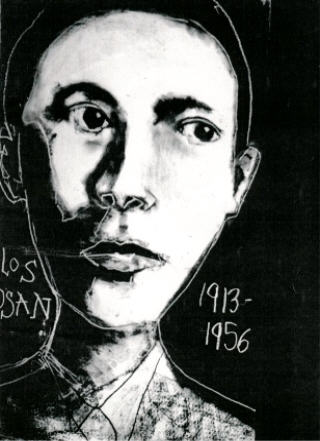
Wednesday, May 01, 2019

On a Censored Poem in the PHILIPPINE COLLEGIAN, 1957


DILIMAN SOUVENIRS: Charles Sanders Peirce's Interpretants and the Return of the Suppressed

by E. San Juan, Jr.
Professorial Chairholder, Polytechnic University of the Philippines


It was not terra incognita. Returning to the University of the Philippines, Diliman, in Jan-March 2018 as a visiting professor of English & Compatative Literature has been not only deja vue but also deja connu.  Not entirely, though.  One can never return home again.  You can never step into the same river again, said Heraclitus. But it has been a learning experience for me, rereading Saussure, Jakobson, Lacan, Barthes, Irigaray, Derrida, Said, Foucault, etc.  These “monsters,” not masters, have provoked, alarmed, or bewildered our smart students.---one of them coming all the way from Nueva Ecija to attend our Wednesday sessions. If I use the personal pronoun here, please consider it also as an allegorical stand-in for the generation that grew up after Liberation, from 1945 to 1965. Maybe postmillenials now….

Of course, the speaking subject here cannot be enclosed in that time-space. So it's puzzling who is speaking, from the viewpoint of the hermeneutics of suspicion. One suspects that every act of remembering, esp. one linked to institutional memory, like attempts at translation, is an act of betrayal of sorts.

Historicizing from the Dustbin

This is not the first time I have engaged in teaching here. After I graduated in 1958, the patriarchs of the Department Prof Cristino Jamias and Leopoldo Yabes hired me as an instructor from 1958 to 1960.  In due time, the patriarchal order was fortuitously changed; my contemporaries Pete Daroy, Ernie Manalo, Max Ramos Jr. and others departed long ago for the other shore; and so too, mentors like Ricardo Pascual, Alfredo Lagmay, Cesar Majul, etc. After finishing graduate school in Cambridge, Massachusetts, I taught again in 1966-67 when world-famous  Carlos P. Romulo was president. I taught again here in 1987-88 as a Fulbright teaching fellow, and in 2008 sheperded the theory seminar with Prof. Preachy Legasto. This may be my last stint, a memorable one, thanks to all our colleagues and assistants in the Department.

Just a few snapshot of the Fifties: My first teachers in English 1 were Prof Elmer Ordonez whose memorable assignment was for us to interpret Ivan Bunin's  classic story"The Gentleman from San Francisco" included in the old WW2 pocketbook collection of short stories; and Prof. Franz Arcellana, who wrote slowly on the blackboard, with his left hand, the definition of "precis" taken from the big Harry Shaw textbook in Freshman English. 

But it was the textbook Approach to Literature by Cleanth Brooks and Robert Penn Warren, the archpriests of American New Criticism, which, I think, made a lasting impact on us as English majors then. After that, I switched my interest to philosophy (Alfred Ayer's Language, Truth and Logic became our treasured scripture, which did not prevent me from reading Sartre, Camus, Kierkegaard, Malraux, etc.), having made friends with students and teachers in that department, in particular Armando Bonifacio, Gerry Acay, and other heretics, whose periodical Inquiry published Franz's comment on my poem which I will refer to later. 

A short parenthesis: my textbook learning faded, but one lesson that stuck was the time Prof. N.V.M. Gonzalez, whose creative writing course was dominated by one single book, Herbert Read's English Prose Style--Prof Gonzalez  took members of the class to attend the Manila Trial Court in City Hall to witness the drama of the libel suit againt Estrella Alfon for the obscenity of her story, "Fairy Tale of the City." That excursion outside the classroom conveyed to me the undeniable entanglement of art, disciplinary institutions (aside from the classroom), and the sociopolitical regime affecting human conduct. Later on, when I wrote a review of Signatures (edited by colleagues Alex Hufana and Rony Diaa) at  Franz's request, I was threatened with a lawsuit filed by the poet Oscar de Zuniga who was offended by my unkindly comment on his contribution to the review.

One scenario sticks out from my years of sitting at the table at the far end of the Dept: Prof Pascual Capiz, sitting at the opposite end, always finding the opportunity to advise me: "Read Spinoza, Sonny, don't forget Spinoza." Four decades after, I read a paper on "What we can learn about racism from Benedict Spinoza" to an audience at the University of Texas, Austin, in 2002.


Interlude

What intervened after my apprenticeship with formalist New Criticism--my book on Oscar Wilde, despite the philological-historicist bent of my advisers Jerome Buckley and Douglas Bush, is basically formalist, not really contextualized in the gender wars then brewing in the early sixties--anti-Vietnam War and Civil Rights and Women's Liberation movements culminating in May 1968--as well as the First Quarter Storm, the Diliman Commune, and the imposition of the Marcos dictatorship in 1972. My U.P. Press book, Carlos Bulosan and the Imagination of the Class Struggle (released a day or two before Marcos declared martial law), was still largely a formalist commentary of Bulosan's writing. Notwithstanding the title, it was a symptom of a cultural lag, typical of our backward or underdeveloped social formation, unsynchronized with the structuralist and post-structuralist tide that swept the Western academy from 1968 to 1986.  Nothing strange for a neocolony, not postcolony, experiencing the turbulence of the crisis of global capitalism via the Marcos authoritarian interlude.

The influence of the changes that occurred, in particular the revision of the canon, and the transformation of critical frameworks/paradigms--the eruption of feminist, ethnic, and subaltern/people-of-color agencies in the social text--overlaid/reconfigured my previous New Critical horizon. I did not jettison my formalist training--how could one do that? One's consciousness is determined by one's social conditioning. Adjustments had to be made, resulting into a palimpsest of texts that requires an inventory (to heed Gramsci's advice).  

One's identity is always the site of an intertextuality traversing the dialectic of base and superstructure, often overshooting it. Marks of its effect may be found in the much-attacked book from left and right, Subversions of Desire: Prolegomena to Nick Joaquin in 1988. 

Unbeknowst to the public, it will be reprinted by the Dominicans of the University of Santo Tomas, since the Jesuits are no longer interested in the unorthodox, difficult and eclectic discourse filled with references to Lacan, Foucault, Benjamin, Jameson, Deleuze-Guattari. and Kristeva. They prefer the Nazi sympathizer Heidegger and the Jewish mystic Emmanuel Levinas. This will be my excuse, at this juncture,  to transit to the problem of semiotics based on the Saussurean premise that orients both structuralist and postmodernist thinking (including postcolonial criticism) so fashionable still, though Derrida has been replaced by Butler, Ranciere, Badiou, Agamben, and other European imports to the metropole of the declining but still ferocious American Leviathan of the Trump era.

Signifiers Galore

     Even before May 1968, the deluge of the dancing signifiers had begun to wreak havoc on the conservative bastions of higher humanistic learning. As everyone knows, a crucial event was the 1967 Johns Hopkins Conference on "The Languages of Criticism and the Sciences of Man," where the archpriests of poststructuralism (Lacan, Derrida, Barthes, Goldman, Todorov, etc.) entered the scene, literary theory and criticism suffered a sea-change, as it were. 

In After Theory, Terry Eagleton summed up the historic contexts of 1965-1980--"the age of civil rights and student insurgency, national liberation fronts, anti-war and anti-nuclear campaigns, the emergence of the women's movement, and the heyday of cultural liberation," in which the sensibility of society had "shifted from the earnest, self-disciplined and submissive to the cool, hedonistic and insubordinate. If there was widespread disaffection, there was also visionary hope" (825) in consumerist, narcissitic society of the spectacle. 

The present conjuncture seemed then "the herald of a new future, the portal to a land of  boundless possibility"--until 1989, the collapse of the Berlin Wall, shock therapy for the Soviet system, followed closely by the Iraq War, 9 /11 and the global war on terrorism, and the erosion of the Neoliberal dispensation from the 2008 global capitalist earthquake and the explosions in Libya, Yemen, Afghanistan, Syria and the entire Middle East. We are still living the aftershock of those events. For some, the age of identity politics aka the culture of neoconservative reaction began, overshadowing the fall of the Berlin Wall, demise of the Soviet Union, Tiananman Square, 9/11, and the 2008 neoliberal capitalist meltdown, and the election of Trump and his neofascist "America First" agenda.


To understand this re-arrangement of the furniture in the landscape, I urged our graduate students to review Saussure's foundational remarks on the dyadic structure of the sign, and the larger frame of Jakobson's six functions of language in communication.  What has become salient is the arbitrary nature of the signifier-signified nexus, with the inference that meaning is produced by systematic differences. Its divorce from objective reality seems assumed, though parole/speech thrives somewhere out there defying lawful order and any fixed rule. The Russian Marxist Mikhail Bakhtin was unheard of, and Roman Jakobson forgotten. Meanwhile, the enigmatic influence of Lacan signaled the advent of deconstruction, with signifiers shifting over the signified, meaning not only deferred or undecidable, but virtually impossible to pin down. For Lacan, actually, the Name-of-the-Father terminates the sliding of signifiers, thus his infamous phallocentrism overheard in chic salon conversations.

Another parenthesis: when I took a class with I.A. Richards in poetics in my first year at Harvard--I recall Ching Dadufalza exulting over her acquaintance with the founder of close formalist reading--he of course
assigned his book Coleridge on Imagination, as expected. But what surprised me was his strong recommendation that we study carefully Jakobson's 1958 landmark essay, "Linguistics and Poetics," given at a conference in Indiana University, but only published later in 1960 in the book Style in Language, which Richards also assigned. Contrary to the canonical views, Richards was not really a formalist but a neoHegelian pedagogue informed by the entire Western heritage and enriched by borrowings from Mencius and then current behavior psychology.

I reminded our students not to forget Jakobson's linguistic analysis. If Jakobson's diagram on the functions of language were absorbed and popularized, it would have exerted some brake on the prevalence of Nietzschean/ theorizing applied by Derrida, De Man, Hartman, Spivak, and their huge academic following. Jakobson's formula on the axis of similarity (metaphor) imposed on the axis of contiguity (metonymy), remains unexplored. To quote Jakobson: "The poetic function projects the principle of equivalence from the axis of selection into the axis of combination" (39). But instead of this linguistic knowledge used by teachers, it is Lacan's "floating signifiers" that have ruled the day ever since it was given in 1957 and publicized in translation in 1966. Students' perplexity over Lacan persists, despite Jakobson and the salutary warnings of the American philosopher Charles Sanders Peirce.

Absent the Author

      It is no longer news to learn of the author's demise (announced by Roland Barthes) in between the interstitial locus of differance. By author, Barthes referred to the empiricist and rationalist conception of the individual origin of the text, its final signified. This classical idea of author presumably encloses the text within a single meaning enshrined in the author's biography, instead of allowing its intertextuality to induce a variety of readers to produce multiple readings. From the modernist, avantgarde perspective, the texts of Mallarme, Joyce, etc. are considered the occasions of language, the circuit of signifiers speaking; they are not the author's psyche, or a representation of its subjectivity, its interiority. Presumably the narrators of Proust's novel, or of Ulysses, are generated by the textual machine without anyone programming it--it's DNA is the differential logic operating within it. 

In "What is an Author?" Michel Foucault has also informed us that the author-function is historically variable. It is defined by a variety of discourses and institutions (for example, copyright laws). Ancient epics or medieval romances do not have authors in the modern construal of individual originators or artificers. Foucault's argument is tied to the death of the human subject, the Cartesian ego, determined not by conscience but by historically specific structures circumscribing its socio-political existence. Thus writing is not something that can be completed and appropriated but an interminable practice, a postmodern theme epitomized by Samuel Beckett's character saying: "What does it matter who is speaking," someone said, what does it matter who is speaking?"

Can Peirce's Intervention Identify the Speaker?

    On second thought, it matters who is being addressed, who is listening or overhearing these utterances. 

For now, I  will quickly summarize Peirce's semiotic triad so as to get to the prime exhibit for today, the putatively notorious poem "Man is a Political Animal." 

For Peirce, meaning is produced by the triad of signifier (representamen), the object signified, and the interpretant which connects signifier and signified. The representamen is something which stands to somebody for something; it addresses someone and creates in the mind an equivalent sign, the interpretant of the first sign, and this too stands for something, namely, the object or idea of that first sign. Communication is the result of the interplay between representamen, interpretant, and object/idea. 

This mediating item in Peirce's theory of signification,or meaning-production, namely, the interpretant, is missing or invisible in the Saussurean dyadic scheme. Without this interpretant, it is impossible to figure out what connects the signifier and the hypothetical signified. Robert Scholes remarks that, following Saussure, signs do not refer to things, "they signify concept, concepts are aspects of thought, not of reality." We move then into the realm of thought.

Peirce is recognized as the founder of pragmaticism, not the psychologistic version of pragmatism popularized by his friend William James, or the postmodern version of antifoundationalism propagated by Richard Rorty. Peirce's maxim or principle was first fomulated in his 1878 essay "How to Make Our Ideras Clear": "In order to ascertain the meaning of an intellectual conception we should consider what practical consequences might conceivably result by necessity from the truth of that conception; and the sum of these consequences will constitute the entire meaning of the conception."  Peirce explained that the "sum of these consequences" is equivalent to a process of rational conduct open to fallibilistic inquiry. The early Peirce may have speculated on infinite semiosis, as Eco and Derrida supposed. Later on he concluded that we should strive for a "concrete reasonableness" and its embodiment in a community of inquirers open to the impact of experience, the intractable factuality of an objective world, the historicity of life, and the inflluence of traditions" (Hoopes).

     To go back to the connection between the signifier and the signified, namely, the interpretant, Peirce enumerates three possible forms of interpretant (in his "Letters to Lady Welby"):  "the interpretant as represented or meant to be understood, its interpretant as it is produced; and its interpretant in itself." There are two main kinds of interpretants: the dynamic interpretant, and immediate interpretant. Later in his life, Peirce speculated on the third kind of interpretant, the logical or final interpretant that would sum up the finidings of the first two. The dynamic interpretant can treat the sign/signifiers as something the reasonableness of which will be acknowledged; or as an act of insistence; or something for contemplation.  Meanwhile, the immediate interpretant considers the signifiers into three kinds: 1) those interpretable in thoughts or other signs of the same kind in infinite series; 2) those which are interpretable in actual experiences; and 3) those which are interpretable in qualities or feelings.

Examine the published reactions to the poem in question. If we look at the three interpretants you have, those by Amador Daguio, Ramon Tapales, and Franz Arcellana, the first two can be classified as examples of immediate interpretants: they translate the poem into actual experiences that are morally censurable, invoking convention and disciplinary codes or instruments of punishment. Meanwhile the third would exemplify the dynamic interpretant that treat the poem as something reasonable, but would judge its performance as lacking in qualities or feelings--not actual experiences--ascribable to an accomplished work of art. It would invoke the institution of like-minded arbiters of taste. In short the first two interpretants draw inferences outside the parameter of aesthetics, while the third confines itself to the value of the signifiers/representamen as inadequate to expressing a hypothetical idea of art implied by the critic.

I would like to read my 2008 reflection on this incident in my book BALIKBAYANG SINTA (pp. 249-252) as one more proof that the subject is indeed constructed through difference. Or, if not bifurcated, the subject-in-question is pluralized by time-space mutations.  The subject speaking/writing in 2008 differs/defers from the subject playing author in 1957. Likewise, the subject now speaking today, March 13, 2018. 

However, despite this disjunctions, this does not imply that meaning is forever deferred, even though the context is unstable, unfixed, relational, or essentially undecidable. Indeed, one may discern an aporia in the rhetoric of the poem,  the rubric "political animal" of Aristotelian origin clashing with the Browningesque dramatic monologue imitated from model poems of Ezra Pound and Wyndham Lewis, editor of avantgarde publications like BLAST in the London milieu of the first two decades of last century.  Of all the reactors, Franz Arcellana, who never really censored the poem as adviser of the Collegian then--Franz confessed to me in 1987 that he was a "fall guy" during that time, as if to exonerate himself. 

Provisional  Epilogue 

I am deeply grateful to Franz Arcellana for encouraging me during my undergraduate days, and as a token of this gratitude I wrote the commmentary on his short story about Christmas, and on "The Yellow Shawl" in the concluding pages of Toward a People's Literature (pp. 170-173). Personally I did not associate him at all with my suspension--there was no written statement from the UP administration, except a verbal notice from the Editor that they won't print anything from me for a while--because this whole incident was sympatomatic of the religious-secular conflict in the University at that time arising from the role of Father John Delaney and Prof. J.D. Constantino charging Prof Ricardo Pascual and his cohort of agnostics and atheists of communistic leanings.  There are other historic pressures one can notice in this complex conjuncture.

In retrospect, the whole affair was a repercussion of the Cold War and McCarthyism particularized in the neocolonial situation of the Philippines during the regimes of Magsaysay and its successors. Indeed, from 1954 to 1960, the Cold War and its local manifestations (the Huk uprising, local McCarthyism, the violence between local oligarchs, the endemic corruption, gangsterism everywhere) constitute the condition of possibility for the poem and its programmed reactions.

One can perhaps locate somewhere the lesson of this incident in this abstract of the talk: With the death of the "author," the subject-position framed in postmodern critical theory becomes a field of contestation. The linguistic turn in literary studies has made even this subject precarious, repute to be a victim of the perpetual sliding of the Lacanian signifier. As a performing subject of this public discourse, I hope to recover the position of the "author" by recollection of my U.P. experience in the fifties, specifically as the suspended student-writer of a controversial poem. The narration of this event is mediated through various interpretants. With a slight detour through Charles Sanders Peirce's triadic theory of signs, this brief intervention hopes to rescue the protagonists of that field, temporarily stabilized here, from being swallowed forever in the "vertiginous abyss" of socio-cultural "underdevelopment." 

As for the  identity of the subject-in-process, or subject-on-trial, as Julia Kristeva would put it, I seek your indulgence in ending this talk with my 1986 comment on the now historic document,"Declaration of the Coalition of Writers and Artists for Freedom and Democracy." [ See reproduction below of my commentary from Philippine News (October 22-28, 1986) ]  --


Friday, April 05, 2019

HISTORY, CLASS CONSCIOUSNESS, IMPERIALISM: REVISITING BULOSAN'S AMERICA IS IN THE HEART

HISTORY, CLASS CONSCIOUSNESS, IMPERIALISM: RE-VISITING CARLOS BULOSAN’S AMERICA IS IN THE HEART  

[CULTURAL LOGIC, VOL. 23 (2019): 1-15]


by E. San Juan, Jr.  
Professorial Chairholder, Polytechnic University of the Philippines


When America Is in the Heart (AIH) appeared in 1946, the Philippines was about to receive formal independence from the United States after four harrowing years of Japanese barbarism. Filipinos thanked the troops of General Douglas McArthur for their “Liberation.” Bulosan’s book was praised less for its avowed progressive sentiments than for its affirmation of the sacrifices made in Bataan and Corregidor, sacrifices memorialized for their promise of complete national redemption. Bulosan tried to capture the pathos of a long-expected moment of rendezvous among waylaid brothers and lost compatriots. Victory against Japan seemed to wipe out the trauma of the U.S. bloody pacification of the islands from 1899 to 1913, an experience alluded to in Bulosan’s farewell to his brother Leon, a veteran of the European carnage that occurred thousands of miles away from Binalonan, Pangasinan, where Bulosan was born on November 2,1911. 

Two years after his birth, the Filipino-American War ended on June 11, 1913 when General Pershing’s troops slaughtered ten thousand Moros in the Bud Bagsak massacre (Tan). Add this toll to about a million natives killed earlier, we arrive at the initial fruit of President McKinley’s “Benevolent Assimilation” policy justifying the new empire’s possession. Soon the newly established school system and William Howard Taft’s “Filipinization” program produced an entrenched bureaucratic caste with close ties to the feudal landlords and compradors that colluded with tne new rulers up to the Commonwealth period (1935-1946). When this oligarchy accepted the onerous conditions of independence in July 1946, Stanley Karnow wryly remarked that “they submitted voluntarily to their own exploitation,” wishing to become “a favored and exemplary party within a Pax Americana” (330).

Bulosan’s advent into the world was thus counterpointed with such paradoxes and intractable ironies. His initiation was self-contradictory, his psyche charged with aberrant impulses and dispositions. It reflected the quandaries of the times. Jaime Veneracion remarks that “while the Americans supposedly introduced land reform, the effect was the intensification of the tenancy problem” (63). Throughout U.S. ascendancy, fierce antagonisms convulsed the pacified  countryside. One charismatic folk-hero, Felipe Salvador, was hanged for leading a massive peasant rebellion against landlords and their U.S. patrons. Between his birth and departure for the U.S. in 1930, Bulosan might have agonized over the desperate revolts of impoverished farmers in the Colorums of Luzon and elsewhere (Constantino; Sturtevant). In Part I, chapter 8, he describes the 1931 Tayug uprising which he didn’t personally witness. It was led by Pedro Calosa, a veteran of union activism in Hawaii who was jailed for instigating multiethnic strikes and summarily deported back to the colony in 1927. 

Transversal Border-Crossings

How did Filipinos suddenly appear in Hawaii? After three decades of imperial tutelage, the Philippines was transformed into a classic dependency providing raw materials and cheap labor. From 1907 to 1926, more than 100,000 Filipinos were recruited by the Hawaiian sugar plantations. Driven by poverty,  feudal abuses, and bureaucratic repression, Filipinos plotted their journey to the metropole to pursue “the dream of success” broadcast so seductively in the mass-circulated textbooks and mass media that mesmerized Bulosan and his generation. Neither citizens nor aliens, they moved around as “wards” or “nationals.” Neither immigrants nor foreigners, they were denied citizenship, wandering from rural countryside to city ghettos and back. As Carey McWilliams observed, “they were neither fish nor fowl” (x). They explored an enigmatic terra incognita filled with perverse fantasies and tragicomic comeuppances. These derelict expatriates shared W.E. B. DuBois syndrome of “double consciousness”(11), a condition of permanent crisis born in the years of transition from feudal bondage to capitalist alienation. It was a hazardous passage that may explain the ironic turnabouts and precarious balancing acts encountered here, a plight analogous to the misfortunes of the peasantry in Europe when the enclosures of the commons engendered banditry, anarchic mayhem, reprisals, together with the fabled gallery of rogues, tricksters, vagabonds, and rambunctious fugitives.

In this zone of contingencies, Bulosan found himself struggling to survive with his cohort upon arrival in the midst of the Great Depression (1929-33). They became easy victims of labor contractors, agribusiness operatives, gamblers, racist vigilantes, and state security agents (prohibiting their marriage with whites) from Hawaii and California to Alaska. Naïve and vulnerable, they nurtured a sophisticated culture of resistance. Bulosan’s friendship with militant organizer Chris Mensalvas plunged him in the campaigns of the Congress of Industrial Organizations (CIO), such as the 1933 strike of 4,000 Filipinos in Stockton and Salinas, California (San Juan, “Filipinos”). As editor of The New Tide in 1934, Bulosan became acquainted with Richard Wright, William Saroyan, John Fante, Louis Adamic, and Sanora Babb. When he was confined at the Los Angeles General Hospital in 1936-38, it was Sanora Babb and her sister Dorothy who shrewdly apprenticed him to a writer’s vocation. They helped him discover through books “all my world of intellectual possibilities—and a grand dream of bettering society for the working man,” as he confessed (San Juan, Balikbayan 161). While convalescing, he composed fiction satirizing feudal savagery and patriarchal despotism, later gathered in The Laughter of My Father (1944, hereafter Laughter). He also wrote poems rehearsing the themes of AIH collected in Chorus for America (1942), Letter from America (1942), The Voice of Bataan (1943), and in his impassioned ode, “If You Want To Know What We Are (On Becoming 166-68). 

U.S. colonialism dissolved traditional affinities and salvaged pastoral folkways. Bulosan’s adolescent years drew energy from the survival craft of a poor peasant clan in which the fathers and uncles had to reckon with maternal wisdom and bureaucratic humbuggery. In his numerous letters, fiction and essays, Bulosan pays homage to the cunning spirit of his father trying to outwit landlords, merchant-usurers, and petty officials to eke out a bare subsistence. In reconstructing his past, Bulosan revitalized the rich insurgent culture of the dispossessed among whom he grew up. He learned the ethos of a rapidly changing society, its strategy of compromises and tactics of ambivalent temporizing. In response to the philistine putdown of his vignettes as a mode of commercializing exotic mores, Bulosan urged us to attend more to their subtle immanent critique: “My politico-economic ideas are embedded in all my writings….Laughter is not humor; it is satire; it is indictment against an economic system that stifled the growth of the primitive, making him decadent overnight without passing through the various stages of growth and decay” (Feria 273).  Other stories by Bulosan (in The Philippines Is in the Heart) exuded “hidden bitterness” couched in dark humor, his antidote to an imputed trademark optimism. They retold folktales attacking the predatory impostures of the oligarchy and the iniquitous property/power relations afflicting the majority.

One might conclude that Bulosan’s return to the homeland began with the ritual of his departure. His apprenticeship as an organic intellectual of the emergent diaspora began with the effort to understand the trials of his family to overcome feudal-colonial privations. Although Laughter and AIH demonstrated his creative potential, unlike his contemporary Jose Garcia Villa, Bulosan was never genuinely accepted by the Establishment literati. He remained suspect, a subversive pariah from the “boondocks.” His radicalization began with an act of “popular memory” triggered by the circumstances of uprooting and rabid ostracism. Even before the imperialist crisis subsided, Bulosan had already plotted his project of remapping the U.S. cultural-political landscape with his claim in an autobiographical manifesto: “I want to interpret the soul of the Filipinos in this country. What really compelled me to write was to try to understand this country, to find a place in it not only for myself but for my people” (“Autobiography” 267). 

Mapping the Terrain of Friends and Foes

Originally acclaimed as a poignant testimonial of ethnic success, AIH’s epilogue gestures toward a popular-front strategy against global fascism. Written during the war, Bulosan’s quasi-autobiography functions as a geopolitical annal of those years of struggle against white-supremacist violence. It serves as a critique of the paradigm of immigrant success still celebrated by self-serving opinion-makers. Obliquely parodying the Bildungsroman model, AIH presents a massive documentation of the various patterns of racism, exploitation, and spiritual injury suffered by Filipinos from the Depression to the end of World War II. Drifting in a limbo of indeterminacy, the untutored subaltern with libertarian affections and perceptions, Bulosan (refunctioning the author’s name to signify the novelistic persona) survived years of ignominy and unquiet desperation. On the eve of Pearl Harbor, he summed up his group’s ordeals: “Yes, I feel like a criminal running away from a crime I did not commit. And the crime is that I am a Filipino in America” (On Becoming 173).

Whle reading, we are confronted with scenes of abuse, insult, and ruthless murder of these “wards” rendered with naturalistic candor. Their successive dilemmas are spliced with snapshots of escape and recovery--a haunting montage mixing history, confessional diary, and quotidian reports from the frontlines. Except for Part I, the remaining three parts of this book—a polyphonic orchestration of fractals from lived experiences—chart the passage of the youthful sensibility through a landscape of cruel privations and melodramatic entanglements. Performing as both protagonist and witness of events, Bulosan’s itinerary of self-discovery begins with his victimization by corrupt contractors on his arrival in Seattle. This is followed by a series of ordeals after which he, Pollyana-like, concludes by vindicating his faith in “America”—“America” is no longer the arena of painful bloodletting but a magical space “sprung from all our hopes and aspirations.” 

Readers are stunned by the stark disjunction between the brutal reality and the compensatory frame of the interpretation. How do we reconcile this discrepancy between actuality and thought, between fact (the chaotic wasteland) and the honorific label “America” erotically identified with equality and freedom?  Is this simply a sly maneuver to syncopate deluded narrator with subversive author?  Is this Bulosan’s subterfuge of multiplying perspectives in order to demystify the neurosis of his life while investing hope and trust in a future chimerical utopia?    

One way of approaching this incommensurability, this impasse of discrepant readings, has become routine. We can reject the commonsensical thesis that this work belongs to that species of personal reminiscence designed to promote easy assimilation into the proverbial “melting pot.”  Alternatively, one can propose that AIH invents a new literary genre which operates as tne negation of the mythical quest for Americanization—the whitening of dark-skinned indigenes. One can also urge a probing of rhetorical nuances, such as the address to the “American earth” which is deliberately cast in the subjunctive mood, tied to an unfolding process whose horizon is overshadowed by the disasters of Pearl Harbor, Bataan and Corregidor; this procedure culminates in the last chapters which recapitulate the anger, moral panic, and dissidence saturating the lives of Filipinos in the “New World.”  

Hermeneutic Interlude

The mainstream approach to Bulosan’s work is charitable but disingenuous. Whatever the pressures of the Cold War and marketing imperatives, to judge Bulosan’s chronicle of the Filipino struggle to give dignity to their damaged lives as an advertisement for ethnocentric “nationalism” seems unwarranted, if not invidious. It is surely meant to erase all evidence of its profoundly radical, communalist motivation. Perhaps the formalist way to correct this mistake is to identify the trope of personification, the wish-fulfilling imaginary underlying the fictive structure. Who is “America’?  The anguished protagonist answers: Eileen Odell “was undeniably the America I had wanted to find in those frantic days of fear and flight, in those acute hours of hunger and loneliness. This America was human, good, and real.” If Eileen functions as a placeholder or synecdoche for all those who demonstrated compassion for strangers like Filipino migrant-workers, then the abstract referent “America” cannot be conflated with this specific locus signified here. Overall, the redeeming figure is a maternal character with manifold personifications (explored later), insinuated in the author’s solicitous, imploring stance. She represents the singular desire called “America” invoked by the novel’s title.

Viewed from another angle, the idiomatic tenor of the title designates an inward process of acquiring self-awareness. It may be construed as a mode of self-reflexibility, a mode of psychic parthenogenesis. Note the symbolic resonance of such descriptions as he felt “love growing inside him,” leading to ”a new heroism: a feeling of growing with a huge life.”  By metonymic semiosis, the trope of containment intimates pregnancy and deliverance, a symbiosis of outside and inside forces. Although victimized, Bulosan feels remolded into “a new man.” Of crucial importance is the equation of “heart” with “one island, the Philippines,” expanding the image. Bulosan deploys Robinson Crusoe’s individualistic predicament as antithetical comment.  Literally and figuratively, the “heart” becomes a polysemous vehicle that signifies inclusion and exclusion. It functions as a device to reconcile warring drives, tendencies, dispositions.  Its figural use serves to characterize the text as belonging to the allegorical type of fiction where time and space (“chronotope,” in Mikhail Bakhtin’s formulation) are configured in such a way as to realize the vision of an embattled community germinating within the confines of an anomic, disintegrated metropolis.
By deploying imaginative ruses, Bulosan grapples with the bifurcating trajectory of his passage through the American maelstrom. The utopian theme of imagining a community within the fold of an atomized society counterpoints the somewhat morbid realism punctuating the text. It lends plausiblity to the didactic sections where the assured authorial voice seems to compensate for the disoriented protagonist and the episodic plot. The climax of Bulosan’s scheme of educating his compatriots about the unifying thread of their fragmented lives transpires in his extolling the “simplicity of their hearts, nourished in the conviction that ‘America’ is still our unfinished dream.”  Purged of his narcissistic malaise, he confesses: “I was rediscovering myself in their lives.” He thus reject the social-Darwinist postulate of the wolf embedded in every person, replacing it with the Moses/mother motif of empathy and conviviality.  

Forking Arguments, Discordant Flows

We soon observe how the narrator’s ego merges with the spirit of an enlarged “family” whose members are bound by a transcendent purpose, a universal principle: the fight against fascist terrorism. This moment anticipates what Bulosan would later call “the revolution” where ordinary workers would “play our own role in the turbulent drama of history…the one and only common thread that bound us together, white and black and brown, in America.” In Chapter 25, we find the narrator harping on the metaphor of the old world dying while a new world is struggling to be born, intuited from the belief that “America is in the hearts of men that died for freedom….a prophecy of a new society.”  Framed by Bulosan’s cathartic discovery of his writing ability linked to his vision of “the war between labor and capital,” the  apostrophe to the multiracial army of workers as “America” is better cognized as part of Bulosan’s project of re-articulating the discourse of popular rights in a socialist direction. But the invocation of a divided “America”—a unity of opposites—presages a recursive aporia, a troubling paradox, an irksome undecidability.  Note that the theme of solidarity was broached first in Bulosan’s desire “to know [the hoboes in the freight trains] and to be a part of their life.” Eventually, the call for partisanship animates the dialectical structure of feeling, the ethico-political disposition concerning the Spanish Civil War, the key historical contradiction here that inflects the binarisms of city/countryside, metropole and colony, consciousness and the public sphere. 

So far the categorizing principle of popular-front-democracy-against-fascism occupies the foreground of Bulosan’s historiography. Here Japanese aggression evokes the earlier U.S. pacification of the islands, the primal event of conquest and deracination. The dissolution of the old order signaled by the war’s outbreak seems to resolve the tension between trivializing idealism and empirical mimesis.  It offers the opportunity for a fantasized resolution, one that will mediate between the notion of “America” as a classless society and its institutionalized racist exclusivism. A poetic mechanism of compensatory fulfillment is rendered here when the truth of colonial subjugation becomes the repressed traumatic object returning to the surface of quotidian existence. Bulosan himself points out that as exiles “socially strangled in America,” instrumentalized and commodified, Filipinos find it easier “to integrate ourselves in a universal ideal,” with organic intellectuals serving as the tribune of the “wretched of the earth” (Fanon), enslaved and disenfranchised peoples mobilizing around the planet.

We discern the crucial turn of Bulosan’s life at the exact middle of the book (Chapter 23).  Struggling to communicate to his fugitive brother, he reconstructs his past and gains release from the prison of silence to “tell the world what they’ve done to me.” The victim thus recovers poise and mutates into an agency fusing theory and practice. This discovery of the capacity for inspired speech-acts occurs after he rebels two chapters earlier: “I had struck at the white world, at last; and I felt free.” Finally, when he meets the lawyer Pascual, Bulosan assumes his role as witness/spokesperson for the grassroots movement. Now he conceives literary art as the symbolic theater of his death and rebirth, and his role within it as a transformative agent, a productive “transindividual” (Goldmann) empowering the rise of a community of equals.

Discourse of Detours and Disjunctures

What becomes symptomatic at this juncture is a shift in rhetoric and style. The memoir’s realistic stance and its affinities with picaresque naturalism (marked by the intrusions of petty crimes, rough diction, squalid surroundings) are disrupted by lyricized nostalgic recalls of an idyllic homeland. By this time, the generic norms of traditional autobiography, using the typical coding for verisimilitude and linear plotting, have already been qualified by a lively comic rhythm of reiteration and recovery. Characters appear and disappear with uncanny gusto. Incidents swerve and replicate themselves while the nuances of dialogue are reprogrammed in a carnivalesque circulation of energies. Polyphonic voices fill the void of Filipino lives until the crisis of hegemonic representation arrives, with emotion-laden scenarios displaced by reflexive meditation at the end.

In Part III, a decisive break occurs. This destroys the model of the successful immigrant and its iconic aura. On this edge of the narrative looms impending failure. Bulosan’s fantasized “conspiracy” of making “a better America” is suspended by the collapse of the body and its grim endurance.  History materializes in the return of the “child” as invalid, the agony of wandering now displaced by the stasis of physical breakdown. Epitomized here is the vitality of the comic genre—the cycle of death and rebirth in “monumental” time—which manifests itself in the body of the expatriate who “died many deaths” between exile and imagined return. Bulosan has dared to transcribe a hazardous reconnaissance of the American heartland. In the process, he celebrates several deaths, one of which is the suicide of Estevan whose story about his hometown precipitates a spiritual conversion: “I began to rediscover my native land, and the cultural  roots there that had nourished me, and I felt a great urge to identify myself with the social awakening of my people.” Recalling previous disappointments, those deaths impregnate the psyche and resurrects the repressed subliminal forces in the language of incongrous, disjunctive confrontations.

In-depth semiotic inquiry would pursue the trope of prophetic homecoming informing the structure of the dream (in Chapter 40) which functions as a synecdoche for what is repressed. Misrecognized as “the Filipino communist” strike leader, the narrator flees from the police. Falling asleep on a bus, the fugitive dreams of his return to his hometown and rejoices at seeing his mother and the whole family eating together. Jolted by “tears of remembrance” at this reunion, he asks himself how the “tragedy” of his childhood had returned in his sleep “because I had forgotten it.” What had been erased from consciousness is his youth in the occupied homeland, a section of profound ethico-political significance, foregrounding the resourcefulness, strength, courage, and intransigence of the peasantry and plebeian masses. By subtle stylistic modalities, Bulosan’s narrative heightens a recursive tempo that seeks to register the power of the peasantry’s (now migrant-workers’) collective agency

In retrospect, Bulosan’s illness—his confinement at the Los Angeles Hospital where the notion of a community larger than the male-bonding of Filipino bachelors proves regenerative—becomes not a gratuitous interruption but a pivotal event.  It halts the spatial discontinuity, the labyrinthine route of his adventure. It ushers the protagonist into a recognition of his new vocation, not so much as the fabulist of Laughter as the archivalist of popular memory. The myriad recognition scenes interspersed throughout function as the healing refrain that repudiates the vexatious fatality limiting his hopes. This potential for reconciliation informs his covenant with the “associated producers” of the ravished homeland, peasants and farmworkers as bearers of an emancipated future.


Tracking the Labor of the Negative

From a broader historical standpoint, AIH may be appraised as the first example of a new genre in the archive, a popular-front allegory attuned to the frightful lanscape of the Depression and total World War (Denning). This form articulates the problems of class, race, nation, and gender in an elaborate, overdetermined configuration painstakingly unravelled in a sequence of surprising but familiar incidents. But what I think constitutes AIH’s originality is its rendering of what Julia Kristeva calls “woman’s time.” This is the subtext or “political unconscious” (Jameson) constituting the unorthodox singularity of this memoir.  Comedy and the symbolic dynamics of the unconscious interact with the realist code of story-telling to generate this new artifice. 

Examining the ambiguous role of women in Bulosan’s “pilgrimage” in inhospitable territory, we discover representatives of its Otherness, its antithetical mirror-image. One recalls how Bulosan praised the exuberant resourcefulness of his mother, that “dynamic little peasant woman”: “[T]o know my mother’s name was to know the password into the secrets of the soul, into childhood and pleasant memories,…a guiding star, a talisman, a charm that lights us to manhood and decency” (America 123). Her genial figure is sublimated in the feisty samaritanic women interrogating patriarchal authority. She is reincarnated in his loyal female companions— emblems of the hidden “Other,” the oppositional mask of an indifferent if not hostile America.  Can we consider AIH a protofeminist text interweaving the nomadic and sedentary lines of action, of flight and confrontation?

By now we are inclined to consider AIH a complex ideological construct meant to resolve real-life contradictions by imaginary fiat, even by a counterfeit resolution, To challenge this, we can deploy an interpretive scheme revolving around women’s time, zeroing in on the image of the mother and other signifiers of need and desire. This move would structure the reader’s horizon of expectation since what, in truth, this  schizoid recollection wants to forget but somehow cannot, is a lacuna whose lingering traces serve as the stigmata of Filipino insurrectos: the genocidal U.S. conquest, with over a million natives killed and a whole civilization ruined. The aftermath preserved feudal-landlord power which suppressed the Colorum and Sakdal uprisings and drove Bulosan and his generation into permanent exile (Francisco; Guerrero; Taruc). In effect, what Bulosan attempts to salvage are the damaged lives of working men and women whose commodified identities have been calculated and dispersed into the predatory flux of “America” where Filipino bachelors found themselves symbolically, if not literally, castrated—a lifeworld libidinally subsumed in the cutthroat laissez-faire market and the mystique of commodity-fetishism now trenchantly sanctified in the dogmas of neoliberal globalization.

Architectonics of Belonging

World War II was almost over when Bulosan’s memoir was completed. McArthur’s shibboleth, “I Shall Return,” had fired up Filipino hopes, motivating Bulosan’s inventory and assessment of the total experience of his generation. In this context, the intent of AIH can be construed as the reinscription of the inaugural moment of loss (U.S. colonization refracted by the Japanese occupation) in the dominant culture by a text that violates conventional expectations. Counterhegemonic reminiscence foregrounds the earth, the tillers’ cooperative sharing, and maternal desire as the ground of meaning and identity. We witness in the end the festive, self-conscious urgent tone of the narrator as he attempts a final reconciliation of the warring forces in his life. His striving for coherence and intelligibility is simultaneously an endeavor to universalize the import and significance of his experience. The final episodes intimate “a return to the source” (Cabral), the time of expropriation and uprooting, inducing a need to retrieve a submerged tradition of indigenous resistance based on principles of solidarity, the concrete universal of this artistic performance. 

Whatever the inherited prejudices of readers, Bulosan seeks to provoke with an inquiry about one’s role in the ongoing drama of social transformation: “Our world was this one, but a new one was being born. We belonged to the old world of confusion; but in this other world—new, bright, promising—we would be unable to meet its demands” (America 324). He calls for the renewal of the social energies that lie dormant in the interstices of the text, partcularly the oppositional and the utopian impulses stifled by acquisitive individualism. For this purpose, we need  a pedagogical method to transcode the unity of opposites here into humankind’s agon of exposing duplicities, reaffirming the value of scientific inquiry, and discriminating what is reactionary and what is progressive, in the heterogeneous micropolitics of daily life.  

Mindful of the uncouth realism mediating existential reality, we can appreciate AIH’s modernist temper in privileging autonomy, imaginative transcendence, and secular humanism. Has the postmodernist taste for pastiche and cynical deconstructivism rendered this book inutile? Conceived as an agent-provocateur, AIH allegorizes the radical transformation of the old system of colonial bondage and culture of silence into one of egalitarian freedom by way of a critical appropriation of diverse embodied ideas entangled in historic contingencies. This process of decolonization enacted by the witness/testifier of AIH is ultimately geared to fashioning a responsible transindividual subject, not a hustling entrepreneur—a task accomplished via reciprocal transactions, ecumenical dialogue, and mutual exchanges among the participants (San Juan, Carlos Bulosan)
At this point I would argue that the evolution of Bulosan’s sensibility transcended the imperatives of nativism, the nostalgic cult of a mythical past, or a yearning for a tolerant cosmopolis. No doubt Bulosan’s “conscientization” (Freire) transgressed nation-state boundaries and upheld proletarian internationalism, as evidenced in poems expressing his commitment to the radical ideals of the Spanish Republic. Bulosan’s engagement with the contentious popular-front strategy afforded him a philosophical worldview which gave direction to his group’s nomadic existence. When the Pacific War broke out,  Bulosan rediscovered the beleaguered islands as the fountainhead of his prophetic, truth-telling advocacy. This served as the germinal site for the paradigm of “national liberation” in AIH, as well as in The Cry and the Dedication (hereafter The Cry), a novel inspired by Bulosan’s friendship with the left-wing activist Amado V. Hernandez, with whom he collaborated in publicizing Luis Taruc’s autobiography, Born of the People.
Vectors of  Intervention

At the start of the Cold War, Bulosan was already a blacklisted writer. The recent discovery of his FBI files seems anticlimactic if not a fortuitous expose of “dirty linen” (Alquizola and Hirabayashi). Bulosan’s intimacy with the astute Babb sisters active in the Hollywood milieu of fellow-travelling intellectuals, was public knowledge. As a journalist with the International Longshoreman’s and Warehouseman’s Union (ILWU), Local 37, Bulosan was regarded as a dangerous subversive, threatened with deportation. But how could the government deport a writer commissioned by President Franklin Roosevelt to celebrate one of the “four freedoms” with an art-work exhibited at the Federal Building in San Francisco in 1943?

By the end of the McCarthy witch-hunt in 1954, Bulosan enjoyed a modest if surreptitious prestige. The best-selling Laughter had been translated into over a dozen languages, while AIH had been favorably reviewed and the author cited in Who’s Who in America, Current Biography, etc. Meanwhile, he was drafting The Cry, his saga of Huk guerrillas reconstructing their nation’s history as they sought to establish linkage with U.S.-based sympathizers (on the Huk uprising, see San Juan, “American Witness”; Taruc).  Allegorizing the improvised self-fashioning of the Filipino subject, The Cry may be read as a performative argument seeking to concretize the right of self-determination. What impelled him to write? “The answer is—my grand dream of equality among men and freedom for all…. Above all and ultimately, to translate the desires and aspirations of the whole Filipino people in the Philippines and abroad in terms relevant to contemporary history. Yes, I have taken unto myself this sole responsibility” (On Becoming 216). Bulosan died on September 11, 1956, three years after the Korean War ended, within earshot of the portentous rumblings from IndoChina.

In retrospect, the tensions of the Cold War offered an occasion for Bulosan to analyze and redefine the self-contradictory predicament that bedevilled the lives of his contemporaries. In grappling with life-and-death contingencies, he reinvented the intertextual conjuncture of class, gender, race, and ethnicity that articulated the epochal conflict between capitalism and the various socialist experiments since the 1917 Bolshevik revolution. A decade after Bulosan’s death, Filipino farm-workers led by his younger comrades began the 1965 strike that led to the founding of the United Farmworkers of America, the fruit of pioneering efforts of the CIO, ILWU, and civic organizations whose leaders were hounded by the FBI and its ideological apparatus. It vindicated the aspiration of these disinherited Asians/Pacific Islanders for justice and respect. Filipinos joined coalitions with African Americans, Chicanos, Native Americans and others in the instructive Civil Rights rebellions, all drawing their energies from a centuries-old memory of resistance—an epic of heroic “soul-making.” Its genealogy was already prefigured in Bulosan’s reflexive aide-memoire, “How My Stories Were Written,” in which an old village story-teller in his hometown is finally revealed as his ancestral progenitor, the fountainhead of all the “wisdom of the heart” (San Juan, Imagination 138-43),

Amid the disruptive controversy over immigration today, over three million Filipinos in the U.S., not counting those “undocumented,” are preponderant stakeholders in the tortuous re-shaping of civil society.  Bulosan endeavored to substantiate their  presence in this chronicle of the subaltern’s quest for recognition and equality. Befor he died, Bulosan reaffirmed his conviction in the virtue of collective praxis as emblematic of humanity’s vast potential in making history: “Writing was not sufficient…I drew inspiration from my active participation in the workers’ movement. The most decisive move that the writer could make was to take his stand with the workers” (“Writer” 31). As long as the Philippines remains a neocolonial backwater, and the Filipino diaspora languishes in obsessive consumerism, Bulosan’s works will remain serviceable as speculative tools for diagnosing its “Unhappy Consciousness” (Hegel) and its ethos of ressentiment, compromise, and disobedience. What Mark Twain called “the Philippine temptation” (32) when the U.S. suppressed its armed inhabitants—the scandalous spectacle of the American republic subjugating millions who refused to be enslaved—yielded a joyful ambidextrous response, to which Bulosan’s life-work bears witness. This arena of struggle over the aesthetic worth and moral gravity of his achievement may prove decisive in extrapolating the vicissitudes and prospects of popular-democratic changes everywhere in this new millennium.—##

WORKS CITED


Alquizola, Marilyn and Lane Hirabayashi. “Carlos Bulosan’s Final Defiant Acts: Achievements During the McCarthy Era.”  Amerasia Journal 38.3 (2012): 29-50.

Babb, Sanora.  Sanora Babb Peprs in the Manuscript Collection, Harry Ransom Center. Carlos Bulosan File. University of Texas, Austin, Texas. Circa 1928-2005. 

Bakhtin, Mikhail.  The Dialogic Imagination.  Austin: University of Texas P, 1981.

Bulosan, Carlos.  America Is in the Heart. Seattle and London: Washington UP, 1973.

——.  “Autobiography.”  Poetry 47 (February 1936): 267.

——.  On Becoming Filipino, ed. E. San Juan, Jr.  Philadelphia: Temple UP, 1995.

Cabral, Amilcar.  Return to the Source.  New York: Monthly Review Press, 1973.

Constantino, Renato.  The Philippines: A Past Revisited.  Quezon City: Tala Publishing Services, 1975.

Denning, Michael.  The Cultural Front.  London: Verso, 1997.

Du Bois, W.E.B.  The Souls of Black Folk.  New York: W.W. Norton, 1999.

Fanon, Frantz.  The Wretched of the Earth. New York: Grove Press, 1968.

Feria, Dolores, ed.  “The Sound of Falling Light: Letters in Exile.” The Diliman Review, viii, 1-3 (Jan-Sept. 1960): 185-278.

Francisco, Luzviminda. “The Philippine-American War.” The Philippines Reader, ed. Daniel B. Schirmer and Stephen Shalom. Boston: South End Press, pp. 8-19.

Freire, Paulo. Education for Critical Consciousness.  New York: The Seabury Press, 1973.

Goldmann, Lucien.  Essays on Method in the Sociology of Literature. St Louis, MO: Telos Press, 1980.

Guerrero, Milagros.  “The Colorum Uprisings.” Asian Studies 5 (April 1967): 65-78.

Hegel, G. W. F.   Phenomenology of Spirit. New York: Oxford UP, 1977.

Jameson, Fredric.  The Political Unconscious.  Ithaca, NY: Cornell UP, 1981.

Karnow, Stanley.  In Our Image.  New York: Random House, 1989.

Kristeva, Julia.  The Kristeva Reader.  New York: Columbia UP, 1986.  

McWilliams, Carey.  “Introduction” to America Is in the Heart by Carlos Bulosan.  Seattle: University of Washington Press, 1973, pp. vii-xxiv.

San Juan, E.  Carlos Bulosan and the Imagination of the Class Struggle. Quezon City:  UP Press, 1972.

—-.  “Filipinos.” In Encyclopedia of the American Left, ed. Mari John Buhle, Paul Buhle and Dan Georgakas.  New York: Oxford UP, pp. 224-226.

—-.  Balikbayang Sinta: An E. San Juan Reader. Quezon City: Ateneo UP, 2008.

—.  “An American Witness to the Huk Rebellion in the Philippines.” Amerasia Journal 40:3 (2014): 55-80.

—.  Carlos Bulosan: Revolutionary Filipino Writer in the United States.  New York: Peter Lang, 2017.

Sturtevant, David.  Popular Uprisings in the Philippines, 1840-1940.  Ithaca, NY: Cornell UP, 1976.

Tan, Samuel K.  The Filipino-American War, 1899-1913.  Quezon City: UP  Press, 2002.

Taruc, Luis.  Born of the People.  New York: International Publishers, 1953.

Twain, Mark. Mark Twain’s Weapons of Satire, ed. Jim Zwick.  Syracuse, NY: Syracuse UP,  1992.

Veneracion, Jaime.  Agos ng Dugong Kayumanggi.  Quezon City: Education Forum, 1987.


###

Sunday, March 24, 2019

National Sovereignty, Anti-Imperialism, and the Iranian Resistance: A Third World Marxist Defence of Iran's Right to Resist Imperialis...